Prices and specs for 300+ vehicles
Every electric and petrol model sold in Nepal, with full specs, photos, variants and the history of what the price has actually done.
Automotive intelligence
Everything a Nepali buyer needs before spending 30 lakh on a car, in one place.
Visit evnewsnepal.com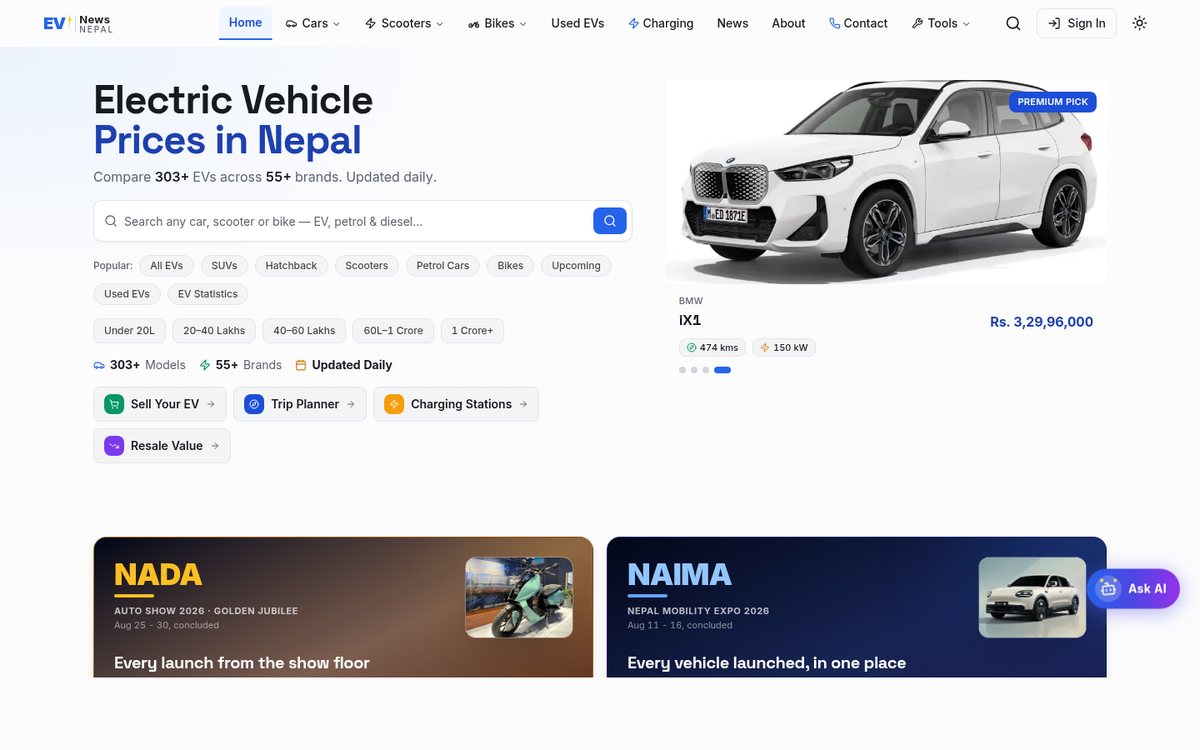
Buying a vehicle in Nepal is a scavenger hunt. Prices live on Facebook pages and in showroom conversations. Specs come from a global brochure that does not match the car sold here. Nobody can tell you what an EV really costs to run against a petrol equivalent, what it will be worth in three years, or whether you can actually reach Pokhara in it. So people end up trusting whichever salesperson they spoke to last.
EV News Nepal is the one place that answers all of it: what exists, what it costs, what it costs to keep, what it is worth later, and where you can charge it. Research, compare, calculate and decide without leaving the site, and without taking anyone's word for it.
What you get
Every electric and petrol model sold in Nepal, with full specs, photos, variants and the history of what the price has actually done.
Pick three vehicles and see every spec in one clean table, instead of opening ten browser tabs.
The real number over years of ownership: fuel or charging, tax, insurance, servicing and depreciation.
Know your exact monthly payment before you walk into a showroom, not after.
Depreciation curves built from real data, so you can see what your vehicle is worth in one, three and five years.
Second-hand listings with condition ratings and battery health, the two things that actually decide a used EV's value.
A live map of charging across Nepal with real-time status, so you know before you drive.
Plan a route with charging stops built in, and a simulation of what your battery will be doing along the way.
Rotate, zoom and inspect 40+ vehicles right in the browser.
Track a specific vehicle and get told the moment its price moves.
Launches, price changes and Nepal registration trends, updated every day.
Ask a question in plain language and get a straight answer about specs, pricing or which car suits you.
Behind the features
Every feature above is powered by something we built. Here is what is actually running.
The assistant
You should not need to learn a filter interface. Ask “which EV under 40 lakh goes furthest” and real vehicles come back, not a page of links.
It does not make things up. The assistant runs an agentic tool-calling loop: the model calls live search tools against our vehicle database and answers only from what those tools return. It also knows which page you are on, so “how does this compare to the Windsor” simply works.
Under the hood: Groq llama-3.3-70b for inference with AWS Bedrock Claude Haiku as automatic failover, FastAPI running the tool loop, MongoDB Atlas for the catalogue, DynamoDB for conversation history and per-user cost tracking.
Trustworthy specs
Importers retune motors, raise suspension and strip features for Nepal, so the global spec sheet is frequently wrong here. When sources disagree, our normalisation layer decides which figure is canonical for Nepal and records why it chose that one.
Anything a local distributor confirmed is protected from being silently overwritten, and anything we cannot verify is flagged for a human rather than published as fact. That is what makes the comparison tables worth trusting.
Honest range
Manufacturers quote range on whichever test cycle flatters them: ARAI, MIDC, NEDC, CLTC, EPA or WLTP. Those figures are not comparable with each other, which makes shopping on range close to meaningless.
We convert every claim into a comparable estimate so you can judge cars fairly, while still showing the manufacturer's original number and the cycle it came from. An honest comparison, without hiding the official figure.
Always current
Launches, price changes and news are ingested continuously from dozens of sources. Anomaly detection catches suspicious changes, a price that suddenly halves or a spec that jumps, and routes them to a human before they ever reach the site.
That is how a very small team keeps 300+ vehicles accurate every day.
Ask AI
Most people do not want to learn an interface. They want to ask a question and get an answer they can act on. The assistant is available throughout the site, knows the vehicle you are looking at, and answers from our own database rather than from whatever a language model happens to remember about cars.
Over the last 16 months. Daily visits grew from 2 to 1,400, entirely from search.